Sewer and drain services
Drain cleaning and stoppage for Pasadena and Anne Arundel County
A slow drain rarely stays a slow drain. We identify what's actually blocking the line, then clear it with the right equipment instead of guessing and hoping it holds.
Chapter 01
Six signs a drain is going
A stoppage usually gives warning before it becomes a full backup. Sinks or showers that drain slower than they used to, a gurgling sound coming back up from the drain after you run water, foul odors drifting up from a pipe that never smelled before, clogs that keep returning no matter how many times you clear them yourself.
Water pooling around a floor drain that's normally dry is another one, and so is the moment several fixtures back up around the same time instead of just one. Any single sign on its own can be minor. Two or three together are worth a call before the line closes off completely.
None of these signs take special knowledge to catch, just attention to what's normal for the house. A shower that used to clear in ten seconds and now takes a minute, a smell near a floor drain that wasn't there last week, a kitchen sink that gurgles every time the washing machine drains nearby. Catching one of them early is usually the difference between a routine clearing and a backup on a Saturday night.
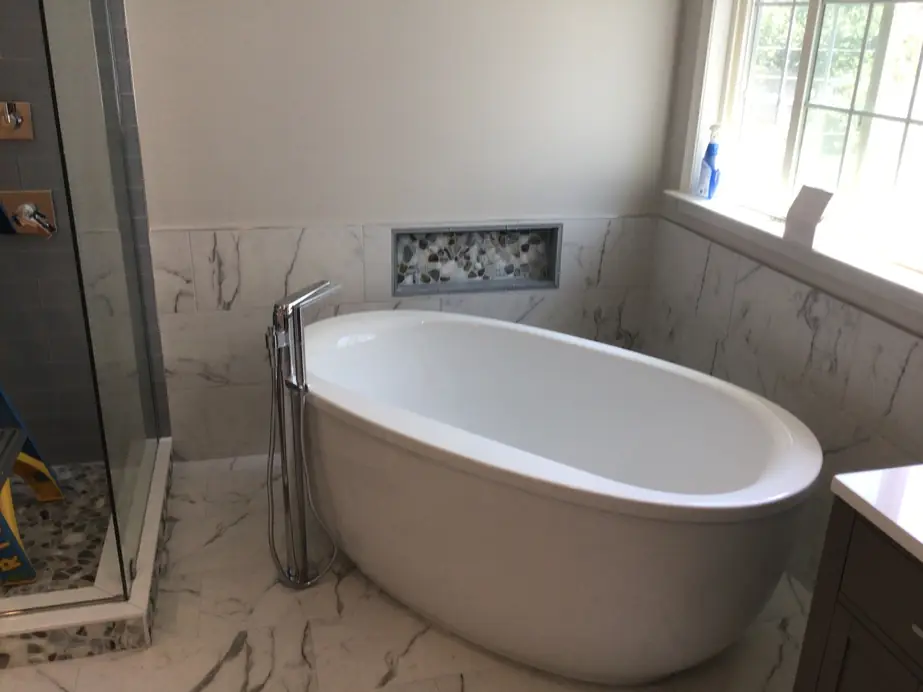
Freestanding tub and marble subway tile in a completed bathroom remodel
One fixture or the whole house
A clog in one sink trap only affects that sink. A stoppage that shows up in more than one fixture at once, especially the lowest drains in the house, usually means the problem has moved past an individual trap and into a shared line.
That distinction changes the approach. Clearing a single fixture is a quick, contained job. A shared-line stoppage points toward the main line, and treating it like a single clogged sink just means clearing the same symptom without fixing what's actually causing it.
A main-line stoppage tends to show up first at the lowest fixture in the house, often a basement floor drain or a ground-floor shower, because that's where water backs up before it ever reaches anything higher. If a floor drain is the first thing acting up, or several fixtures start backing up together, that's worth a call rather than something to mop up and forget about.
Chapter 03
Clearing it properly
We identify the cause before we decide how to clear it, because a grease clog, a root intrusion and a collapsed section of pipe all call for different tools and none of them respond well to a one-size approach.
For the toughest clogs and stoppages we use advanced equipment built for the job, working to restore proper flow through the line rather than punching a hole through the blockage and calling it cleared. A hole gets water moving again for a while. A properly cleared line stays open.
Grease, roots and a physical break in the pipe can all produce the same surface symptom, water that won't go down, without being the same problem underneath. Treating a root intrusion like a grease clog only clears the surface for a few weeks before the actual obstruction grows back and the same call comes in again.
Keeping it clear
What goes down a kitchen drain and what goes down a bathroom drain are different problems over time. Grease and food scraps build up along pipe walls in a kitchen line even when nothing ever technically clogs the trap. Hair, soap scum and toiletries do the same thing on the bathroom side.
If the same line keeps clogging every few months, clearing it again is treating a symptom. A camera inspection shows what's actually happening inside the pipe, root intrusion, a low spot holding standing water, a partial collapse, so the next visit fixes the cause instead of repeating the same temporary fix.
A drain that clears easily every time isn't the one to worry about. It's the line on a repeat schedule, clogging every few months like clockwork, that's telling you something structural is happening below the surface, and that pattern is exactly what a camera inspection is built to find before the next call.
Chesapeake Plumbing — Licensed, insured, and backflow certified. Call (443) 264-4688.